Italy consistently requires skilled welder (saldatore) in manufacturing, metal fabrication, construction, energy, and industrial maintenance. To secure a welding position in Italy by 2026, align your qualifications with local jobs titles, relevant welding processes (MIG, TIG, and stick), and certifications, and utilise the application channels preferred by Italian employers.
This guide outlines job types, requirements, certifications, salary considerations, and recommended platforms for job applications in Italy.
Quick Facts
- Italian job title: Saldatore (welder)
- Standard processes: saldatura a filo (MIG/MAG), TIG, elettrodo (stick)
- Typical employers: metal fabrication shops, industrial plants, precast/infrastructure suppliers, shipyards, maintenance contractors
- Most requested skills: reading technical drawings (disegno tecnico), safe fabrication practices, consistent weld quality
- Best job sources: Indeed Italy, InfoJobs, LinkedIn, Adecco, EURES
Types of Welder Jobs in Italy
Different companies use different titles. Use both English and Italian keywords when searching.
| Job Type | Common Italian Search Terms |
|---|---|
| MIG/MAG Welder | saldatore a filo, MIG/MAG, carpentiere saldatore |
| TIG Welder | saldatore TIG, inox, alluminio |
| Stick / Electrode | saldatore elettrodo, SMAW |
| Fabrication / Structural | carpenteria metallica, saldatura carpenteria |
| Pipe / Plant Maintenance | saldatore tubista, manutenzione industriale |
| Robotic Welding | saldatura robot, addetto saldatura a robot |
Tip: Adding your process to the query (example: “saldatore TIG Milano”) usually improves relevance.
Core Responsibilities Employers Expect
While each factory or workshop differs, most welder jobs in Italy include:
Welding and fabrication
- Assemble and weld metal components to meet specified measurements and strength requirements.
- Perform fit-up, tack welding, finishing, and rework/repair when needed
Reading technical drawings
- Interpret work orders and technical drawings (blueprints) to ensure accurate construction.
- Measure, align, and verify parts before final welding
Material preparation and handling
- Cut, grind, position, and secure components before welding
- Follow safe handling procedures around heavy materials and moving equipment
Quality and safety
- Inspect welds for defects, alignment issues, and consistency
- Follow safety rules and use correct PPE at all times
Requirements and Skills for Welding Jobs (Italy)
- Experience with one or more processes (MIG/MAG, TIG, electrode)
- Ability to read disegno tecnico (technical drawings)
- Comfort working shifts and meeting production deadlines
- Reliability and attention to quality/safety
Language note: Many roles expect a working level of Italian, and some postings explicitly require good Italian.
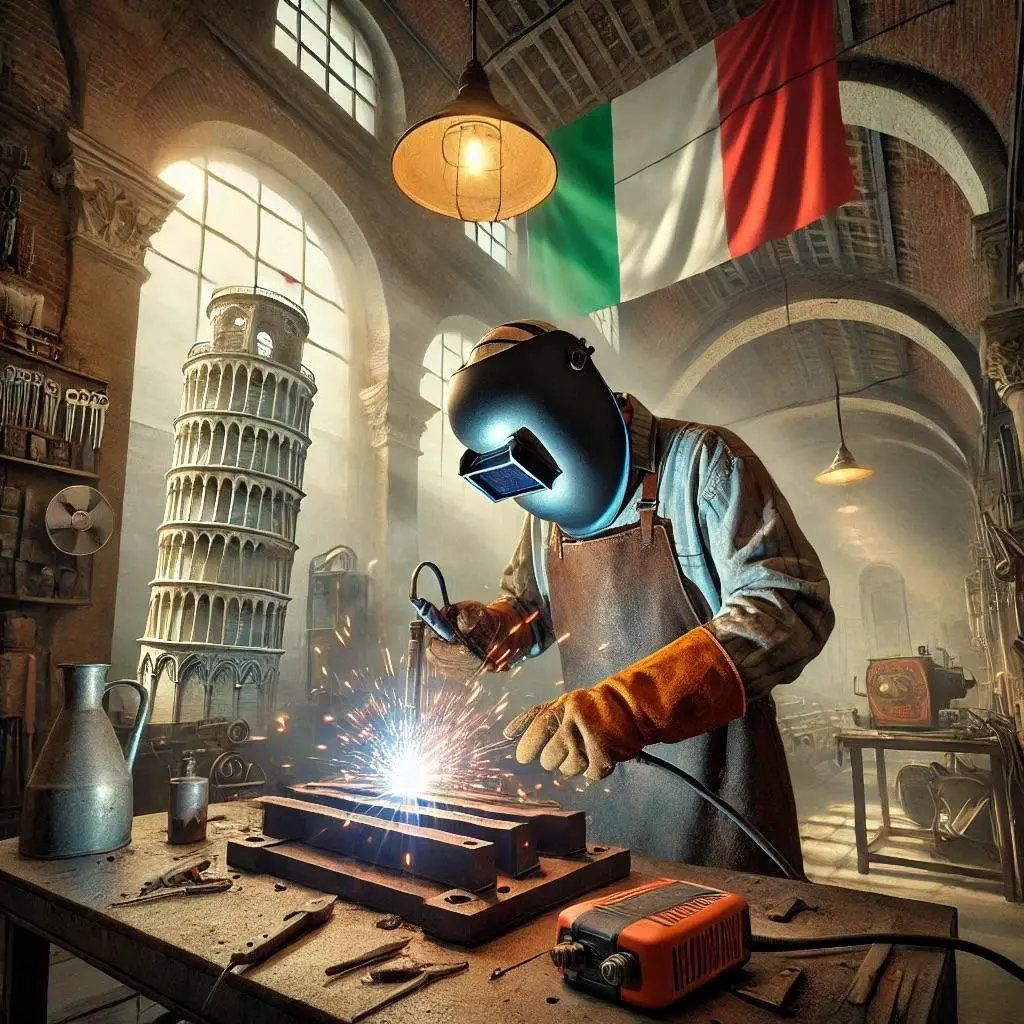
Certifications That Help You Get Hired
In Italy, employers often value a “patente di saldatura” (welder qualification/certification). One widely referenced standard for welder qualification testing is EN ISO 9606-1 (fusion welding of steels).
Good to know: Some employers hire experienced welders even without a current patentino and support obtaining it on the job (as stated in some EURES listings).
Salary in Italy
Pay varies heavily by region, industry (shipbuilding vs. small workshop), shift premiums, and certification level.
- One salary survey source estimates the average welder’s pay at around €40k/year (with a range of roughly €29k–€48k).
- Another source reports lower self-reported hourly figures (based on a small sample), showing why rates can differ by data source and location.
Best practice: treat online figures as benchmarks, then confirm via current job ads in your target city and your experience level.
Best Sites to Find Welder Jobs in Italy
Use multiple platforms so you don’t miss hiring channels:
- Indeed Italy (mass volume of saldatore listings) Indeed +1
- InfoJobs Italia (strong for trades and regional hiring) InfoJobs + 1
- LinkedIn Jobs (good for larger firms and alerts) LinkedIn +1
- Adecco Italy (recruiter-driven hiring, many industrial roles) Adecco +1
- EURES (useful for EU-wide mobility and verified postings) EURES (EURopean Employment Services) + 1
How to Apply and Actually Get Interviews
1) Build an “Italy-ready” CV (ATS + recruiter-friendly)
Include these sections clearly:
- Welding processes (MIG/MAG, TIG, electrode)
- Materials (steel, stainless/inox, aluminum/alluminio)
- The thickness range you’ve welded
- Blueprint reading (disegno tecnico)
- Certifications/patents (or “available to obtain”)
- Safety and quality checks
2) Add the right keywords (English + Italian)
Use a mix like:
- “Saldatore a filo (MIG/MAG)”
- “Saldatore TIG inox”
- “Carpentiere saldatore”
- “Saldatore tubista”
3) Prepare a simple skill proof
If possible, bring:
- Photos of clean welds / finished projects
- A short list of machines you’ve used
- Any certificates (even training completion)
4) Expect practical tests
Many employers run a short weld test (standard in fabrication hiring).
Work Permit and Visa Notes (Non-EU Applicants)
If you are not an EU/EEA/Swiss citizen, working in Italy typically requires a work visa, which is then converted into a residence permit for work purposes upon arrival.
Italy also manages non-EU work entry through quota programmes (often discussed under the Decreto Flussi / Flow Decree). Reuters reported a plan to issue nearly 500,000 non-EU work visas over 2026–2028 through legal immigration channels tied to labour needs.
(This is general information, not legal advice. For your exact case, check official consular guidance and employer sponsorship requirements.)
FAQ: Welder Jobs in Italy
What is a “welder” called in Italy?
Most commonly saldatore.
Do I need a welding certificate (patentino)?
Not always, but it helps. Many employers value certifications aligned with standards like EN ISO 9606-1, and some jobs allow you to obtain the patentino after being hired.
Which welding type is most requested?
MIG/MAG (saldatura a filo) is very common in production, while TIG is frequent for inox and precision work.
Is the Italian language required?
Often yes—many listings prefer or require workable Italian.
Where should I apply first?
Start with Indeed Italy, InfoJobs, LinkedIn, Adecco, and EURES, then set alerts for your city and welding type.